Three key chemical technologies for carbon capture
Three principal chemical technologies are used for CO₂ capture: amine-based absorption, calcium looping, and solid adsorption.
03 min reading
Novel electrochemical device separates electrode environments to accelerate CO₂ uptake while reducing energy consumption, paving the way for scalable carbon capture solutions.
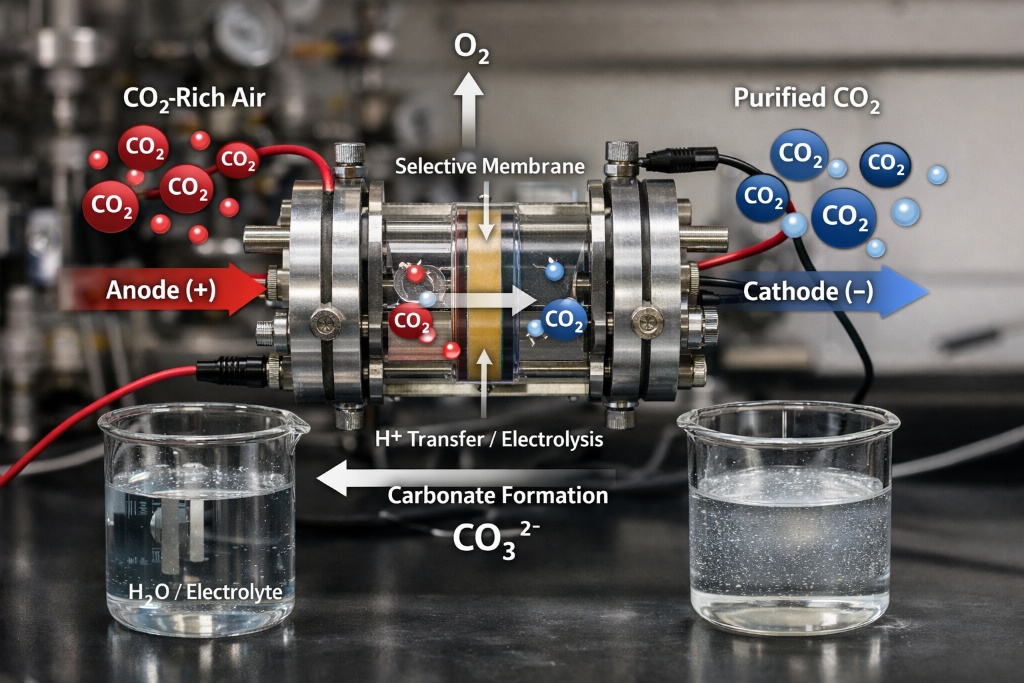
A team of scientists led by Mike Tebyetekerwa and Xiwang Zhang from Australia’s Queensland University has developed a groundbreaking electrochemical carbon capture technology that could dramatically reduce both the energy and time required to remove carbon dioxide from industrial and atmospheric gas streams.
The research, recently published on ChemRxiv, introduces a membrane-integrated supercapacitor system that achieves unprecedented rates of CO₂ capture while consuming minimal energy.
Traditional carbon capture methods are often limited by slow kinetics and high energy demands. By integrating a cation-exchange membrane to separate the electrode compartments, the new system maintains a high concentration of hydroxide ions at the cathode. This creates a localized alkaline interface that rapidly converts CO₂ into (bi)carbonate species through a pH-swing mechanism.
The study highlights the potential of electrochemical pH-swing strategies to provide scalable, environmentally friendly solutions for mitigating climate change. The authors note that such approaches could complement renewable energy infrastructure by capturing carbon efficiently with minimal additional energy input.
Three principal chemical technologies are used for CO₂ capture: amine-based absorption, calcium looping, and solid adsorption.
Scientists have developed a new method to produce green hydrogen directly from seawater using sunlight, offering a promising pathway for clean and sustainable energy.
Japanese scientists at the Institute of Science, Meguro in Tokyo have discovered a new type of liquid that could make capturing carbon dioxide from factories and power plants faster and more efficient.