Solar-Driven Photocatalytic Seawater Splitting for Green Hydrogen Generation
Scientists have developed a new method to produce green hydrogen directly from seawater using sunlight, offering a promising pathway for clean and sustainable energy.
05 min reading

For most organisations, achieving net zero is dictated less by internal operations and more by the suppliers, partners, and activities making up their value chains. While many businesses successfully curb direct operational footprints, these reductions represent only a fraction of their total impact. Instead, Scope 3 emissions—generated from raw material extraction, manufacturing, transportation, product use, and disposal—typically account for the vast majority of total greenhouse gases.Consequently, reaching true climate targets requires a highly coordinated approach that engages stakeholders across the entire product lifecycle. Far from a mere regulatory box-checking exercise, building a sustainable supply chain is now a core strategic priority. Organisations that successfully measure and mitigate these embedded emissions drastically improve their operational efficiency, protect themselves against climate risk, and unlock major advantages for market innovation. In a rapidly transitioning low-carbon economy, supply chain transparency will ultimately separate market leaders from those struggling to adapt.
While every supply chain is different, several practical actions can help organisations build lower-carbon, more resilient operating models (as depicted in image following).
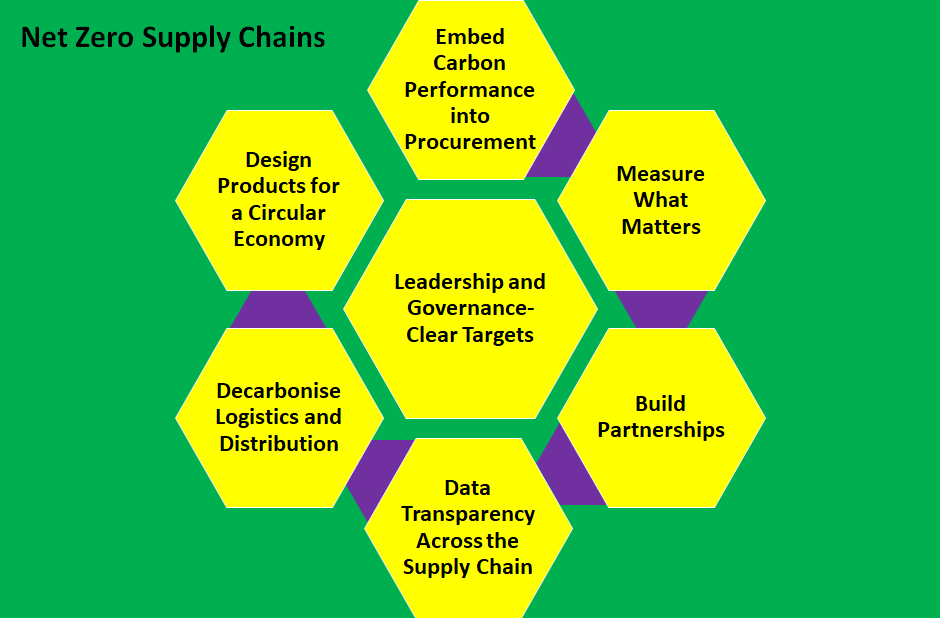
Although many organisations begin by calculating Scope 1 and Scope 2 footprints, the most significant reduction opportunities reside within Scope 3 emissions. Developing a comprehensive emissions inventory is essential for identifying critical hotspots across procurement, manufacturing, logistics, and distribution. By securing reliable data, organisations can confidently establish a baseline, prioritising high-impact actions while accurately tracking their progress over time.
Leading organisations now evaluate suppliers on environmental performance alongside commercial capability. To drive continuous improvement throughout supply networks, procurement strategies must integrate strict sustainability criteria into supplier selection and contract management. This structured approach actively incentivises partners to:
Disclose Footprints: Measure and report comprehensive greenhouse gas emissions.
Target Reductions: Establish ambitious, time-bound decarbonisation goals.
Shift Power: Accelerate the adoption of renewable energy across operations.
Standardise Reporting: Disclose progress via recognised sustainability frameworks.
Many suppliersparticularly SMEslack the internal resources or technical expertise required to accurately measure and mitigate emissions. To bridge this gap, organisations should adopt a deeply collaborative model that offers practical guidance, targeted training, and strategic support. Investing in joint innovation projects, shared reduction programmes, and cross-industry knowledge exchange ultimately yields far more meaningful decarbonisation than compliance-driven mandates alone
Due to limited supplier-specific information, many businesses currently rely on industry-average secondary data. While useful for initial estimates, these generic averages fail to reflect actual operational performance or isolate the highest-impact improvement opportunities. Overcoming this bottleneck requires leveraging digital platforms, improved reporting systems, and advanced data analytics. These technologies grant organisations granular visibility across complex supply networks, enabling data-driven decision-making and highly targeted emissions reductions.
While logistics activities heavily drive value chain footprints, organisations can unlock rapid environmental and financial wins through strategic transport interventions. Transitioning from defensive compliance to active logistics management empowers businesses to systematically slash emissions by:
Decarbonisation begins on the drawing board. By selecting lower-carbon raw materials, minimising total material inputs, and maximizing recycled content, design teams can systematically design out environmental impacts across the product lifecycle. Integrating circular economy principles ensures that products are deliberately engineered for extreme durability, easy repair, refurbishment, and efficient recycling. This structural shift effectively mitigates upstream waste, curtails a costly reliance on finite virgin resources, and creates high-performing assets that retain their economic and material value for as long as possible.
To move beyond vague commitments, organisations must implement robust corporate frameworks aligned with climate science. Transitioning from abstract goals to measurable progress requires tracking key performance indicators across the value chain, specifically:
Ultimately, establishing a regular, public reporting cadence does more than meet regulatory compliance. It builds deep baseline confidence for institutional investors, consumers, and regulators, explicitly proving that your sustainability roadmap is delivering verified, real-world impact.
A decarbonised value chain cannot be achieved through bottom-up operational adjustments alone; it demands absolute leadership, explicit accountability, and rigorous governance. Boards and executive teams must deliberately weave climate considerations into the fabric of corporate strategy, procurement criteria, capital allocation, and risk management frameworks.Rather than treating climate action as a siloed, corporate social responsibility initiative, leadership must govern decarbonisation as a core commercial priority. Equipping teams with unambiguous expectations, adequate capital, and robust ownership frameworks is the only way organisations can successfully accelerate meaningful value chain evolution.
Every participant across the value chain holds a critical lever for reducing global emissions. Organisations that proactively build supplier capability, foster cross-industry collaboration, and invest in joint innovation will be significantly better insulated against future climate, regulatory, and market disruptions. Ultimately, the transition to net zero demands that businesses fundamentally rethink how they source materials, engineer products, manufacture goods, and distribute value. The supply chains of the future will no longer be judged solely by speed and cost, but by their systemic ability to generate commercial value while driving environmental impact to absolute zero.

Dr Chirangano Mangwandi
Senior Lecturer, School of Chemistry and Chemical Engineering
Queen’s University Belfast, United Kingdom
Scientists have developed a new method to produce green hydrogen directly from seawater using sunlight, offering a promising pathway for clean and sustainable energy.
Novel electrochemical device separates electrode environments to accelerate CO₂ uptake while reducing energy consumption, paving the way for scalable carbon capture solutions.
Japanese scientists at the Institute of Science, Meguro in Tokyo have discovered a new type of liquid that could make capturing carbon dioxide from factories and power plants faster and more efficient.