Solar-Driven Photocatalytic Seawater Splitting for Green Hydrogen Generation
Scientists have developed a new method to produce green hydrogen directly from seawater using sunlight, offering a promising pathway for clean and sustainable energy.
05 min reading
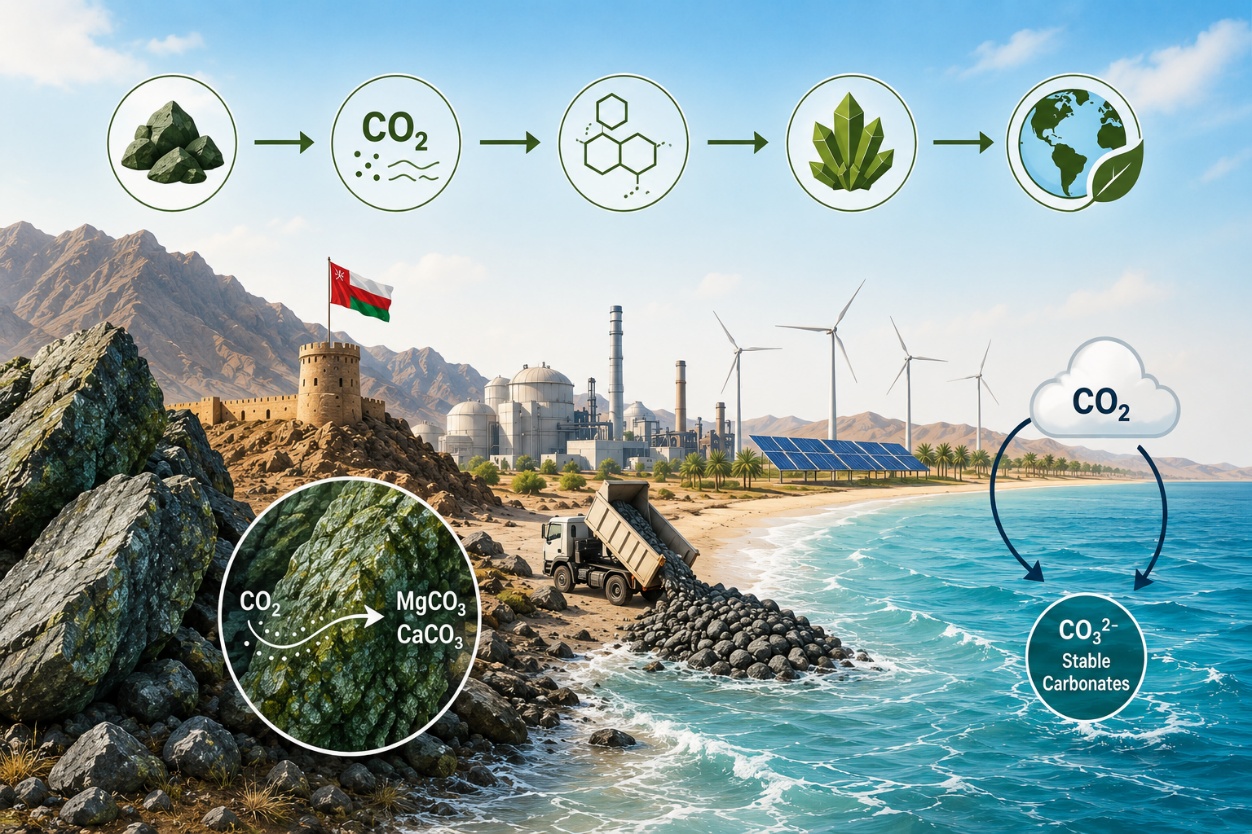
The global commitment to achieving Net Zero greenhouse gas emissions by 2050 has fundamentally reshaped the way nations approach climate change mitigation. Net Zero refers to balancing human-generated greenhouse gas emissions with their removal from the atmosphere through natural or engineered processes. While renewable energy, electrification and energy efficiency remain the cornerstones of decarbonisation, they are unlikely to eliminate emissions from hard-to-abate industries such as cement, steel, mining and petrochemicals. As a result, carbon dioxide removal (CDR) technologies have become an essential component of global climate strategies.
Among the various CDR approaches, mineral carbonation is widely regarded as one of the safest and most permanent methods of carbon storage. This process converts gaseous carbon dioxide into stable carbonate minerals that can remain securely locked within geological formations for thousands to millions of years (Ali et al., 2021).
Oman occupies a unique position in the global Net Zero transition because it hosts one of the world's largest and best-preserved ophiolite complexes, the Semail (Oman) Ophiolite. These ultramafic rocks are naturally rich in magnesium silicate minerals, including olivine and serpentine, which readily react with CO₂ to form stable magnesium and calcium carbonates. For millions of years, natural weathering of these rocks has generated alkaline waters and carbonate deposits, demonstrating the Earth's inherent ability to permanently remove atmospheric carbon dioxide (Ali et al., 2020). Understanding and accelerating these natural processes presents an important opportunity for climate mitigation while supporting sustainable industrial development in Oman.
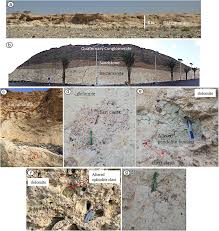
Over the past several years, our research at Sultan Qaboos University has focused on understanding both the natural and engineered pathways of mineral carbonation in Oman. A geochemical and stable isotope investigation of carbonate deposits within the Barzaman Formation demonstrated that atmospheric CO₂ has been naturally captured through water-rock interactions associated with the Oman Ophiolite. Carbon and oxygen isotope analyses revealed that approximately 78 ± 11% of the carbon incorporated into calcite originated directly from atmospheric CO₂, while the remainder was derived from dissolved inorganic carbon (DIC) in groundwater. These findings provide compelling evidence that Oman already hosts an active natural carbon sequestration system and establish a scientific foundation for evaluating engineered enhancement of these natural processes (Ali et al., 2021).
Building on these findings, our recent research has focused on developing reactive mineral materials capable of accelerating carbon mineralisation. By combining lizardite-rich ultramafic rocks with industrial marble waste, we produced a reactive calcined composite that significantly enhances atmospheric CO₂ uptake under ambient conditions (Ali et al., 2026a, 2026b). Laboratory experiments demonstrated the rapid formation of stable carbonate minerals, highlighting a promising pathway for simultaneously removing atmospheric carbon dioxide and valorising industrial waste. This approach strongly aligns with the principles of the circular economy by transforming mining residues and industrial by-products into valuable carbon-negative materials suitable for large-scale deployment.
An important extension of this work is the concept of Coastal Carbon Capture (CCC) (Ali, 2025). With more than 3,000 kilometres of coastline, Oman offers exceptional opportunities to harness the natural interaction between seawater, atmospheric CO₂ and reactive ultramafic minerals. Laboratory studies indicate that spreading crushed olivine- and serpentine-bearing materials in coastal environments can accelerate natural weathering reactions, increase seawater alkalinity and promote long-term carbon sequestration through carbonate precipitation (Ali et al., 2025; Ali et al., 2026). Unlike many conventional carbon capture technologies, CCC does not require concentrated CO₂ sources. Instead, it relies primarily on naturally available atmospheric carbon dioxide and seawater, making it particularly attractive for large-scale deployment in regions rich in ultramafic rocks. Preliminary experimental results also suggest that this approach could help mitigate local ocean acidification while capturing significant quantities of atmospheric carbon dioxide.
Stable isotope geochemistry has been central to these investigations. Carbon and oxygen isotopes serve as powerful tracers for identifying carbon sources, reconstructing reaction pathways and quantifying the relative contributions of atmospheric CO₂, dissolved inorganic carbon and geological carbon reservoirs during carbonate formation (Ali et al., 2021). When combined with mineralogical, petrographic and geochemical analyses, isotope geochemistry enables researchers to distinguish between naturally formed carbonates and those produced through engineered mineral carbonation. These techniques provide robust verification of permanent carbon storage and are becoming increasingly important as governments and industries develop reliable monitoring, reporting and verification systems for carbon removal projects.
The transition to Net Zero requires more than technological innovation. It demands the integration of geological resources, industrial infrastructure and sound environmental stewardship. Oman has already demonstrated strong ambition through investments in renewable energy, green hydrogen production and carbon management initiatives. Mineral carbonation complements these efforts by providing a permanent, low-risk carbon storage solution that can operate alongside existing industrial activities. At the same time, the utilisation of quarry fines, mining residues and industrial waste reduces disposal requirements while creating additional economic value from materials traditionally regarded as waste.
The next step is to move beyond laboratory-scale research towards pilot and field-scale implementation. Future research should focus on optimising reaction kinetics, assessing long-term environmental impacts, quantifying life-cycle carbon balances and developing robust monitoring techniques using geochemical and isotopic tracers. Integrating CCC with desalination plants, industrial clusters and quarry operations could create valuable synergies, accelerate atmospheric CO₂ removal while supporting Oman's transition towards a diversified, low-carbon economy.
To summarise, achieving Net Zero will require a portfolio of complementary climate solutions. Our research demonstrates that Oman possesses exceptional geological resources capable of supporting permanent carbonsequestration through both natural and engineered mineral carbonation. The integration of stable isotope geochemistry, reactive ultramafic minerals, industrial by-product utilisation and CCC represents a scientifically robust and environmentally sustainable pathway for long-term carbon removal. By advancing these technologies from laboratory research to real-world implementation, Oman has the potential to become a global leader in geological carbon sequestration and make a meaningful contribution to international climate goals.
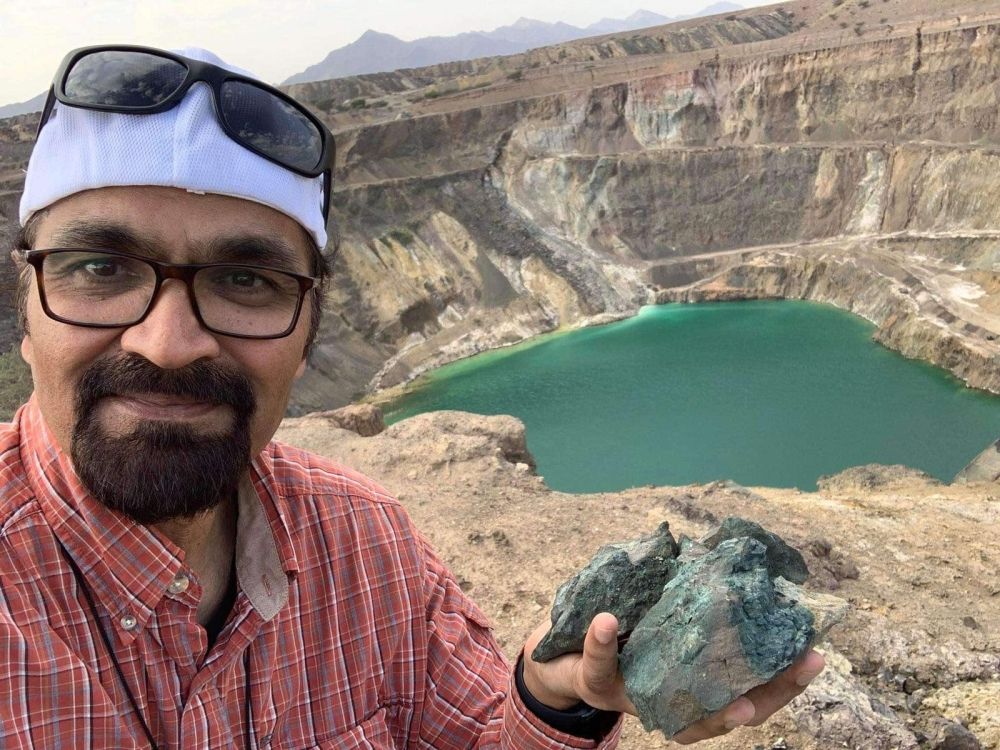
Dr. Arshad Ali
Earth Sciences Research Centre
Sultan Qaboos University (SQU)
Al-Khoudh, Muscat, Sultanate of Oman
Current: STEMiphi Learning Inc., Canada, Co-Founder & Director
Scientists have developed a new method to produce green hydrogen directly from seawater using sunlight, offering a promising pathway for clean and sustainable energy.
Novel electrochemical device separates electrode environments to accelerate CO₂ uptake while reducing energy consumption, paving the way for scalable carbon capture solutions.
Japanese scientists at the Institute of Science, Meguro in Tokyo have discovered a new type of liquid that could make capturing carbon dioxide from factories and power plants faster and more efficient.