Solar-Driven Photocatalytic Seawater Splitting for Green Hydrogen Generation
Scientists have developed a new method to produce green hydrogen directly from seawater using sunlight, offering a promising pathway for clean and sustainable energy.
03 min reading
Conventional amine scrubbing for carbon capture uses heat energy to release CO₂ during the desorption process. High-temperature treatment causes chemical changes in the amines, leading to the formation and release of toxic and carcinogenic compounds such as nitrosamines. The amine regeneration process therefore has a significant negative environmental impact. It also poses serious hazards to workers and the public in the vicinity of post-combustion capture plants that operate based on amine absorption and regeneration. Despite these drawbacks, amine-based CO₂ capture technology remains versatile and widely applied.
In recent years, electrochemical carbon capture methods have emerged as promising alternatives. These methods use electricityrather than heat or high pressureto capture and release CO₂. They often operate at room temperature and can be powered by renewable energy sources, making them attractive alternatives to conventional amine scrubbing.
Recent research efforts have led to continuous improvements in the desorption step of amine scrubbing technology. As a result, Electrochemically Mediated Amine Regeneration (EMAR) was developed to use electrical energy to release CO₂ captured from post-combustion flue gas, thereby avoiding the need for thermal regeneration of amines.
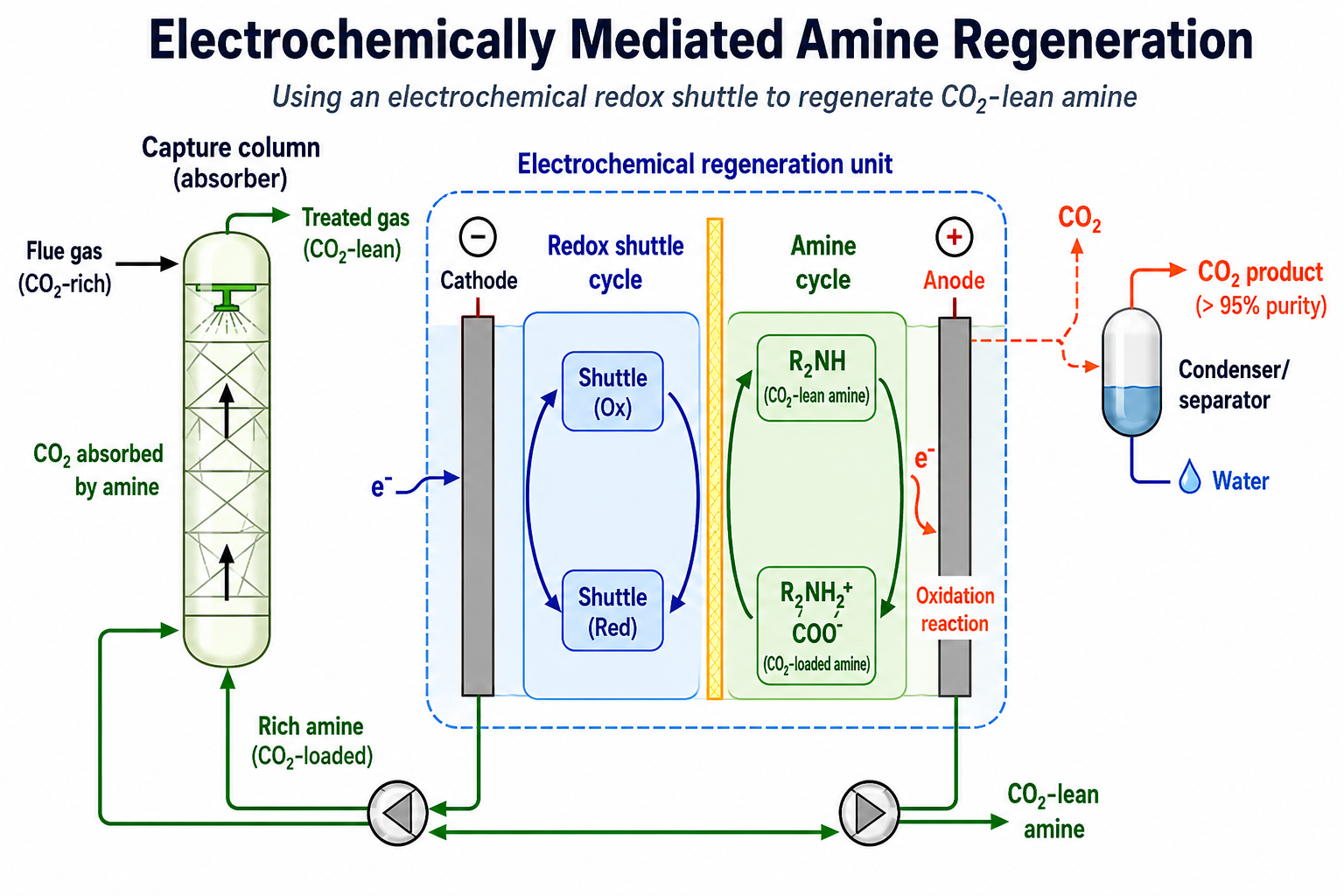
An amine solvent (often ethylenediamine or similar amines) absorbs CO₂ from a gas stream, forming carbamate/bicarbonate species.
2RNH2 + CO2 ⇌ RNHCOO− + RNH3+Instead of heating the solvent in a stripper column, an electrochemical cell is used. A metal ion, commonly copper (Cu²⁺) is generated at the anode and selectively binds to the amine more strongly than CO₂ does.
Cu(s) → Cu2+ + 2e−When the metal complexes with the carbamate, the CO₂ is displaced. Amine now prefers binding Cu²⁺ instead of CO₂, the carbamate breaks down and CO2released as a concentrated gas stream.
RNHCOO− + RNH3+ + Cu2+ → [Cu(RNH2)2]2+ + CO2At the cathode, the metal ions are reduced back tometallic copper and amine is regenerated.
[Cu(RNH2)2]2+ + 2e− → Cu(s) + 2RNH2Aqueous amine + CuSO₄ will act as the electrolyte.Electricity drives a reversible metal–amine coordination cycle that replaces the thermal stripping step used in conventional amine regeneration.
Scientists have developed a new method to produce green hydrogen directly from seawater using sunlight, offering a promising pathway for clean and sustainable energy.
Novel electrochemical device separates electrode environments to accelerate CO₂ uptake while reducing energy consumption, paving the way for scalable carbon capture solutions.
Japanese scientists at the Institute of Science, Meguro in Tokyo have discovered a new type of liquid that could make capturing carbon dioxide from factories and power plants faster and more efficient.